skip to main |
skip to sidebar
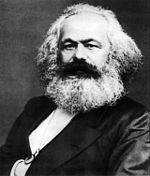
Marxian political economy
Karl Marx considered capitalism to be a historically specific mode of production (the way in which the productive property is owned and controlled, combined with the corresponding social relations between individuals based on their connection with the process of production) in which capitalism has become the dominant mode of production.[31] The capitalist stage of development or "bourgeois society," for Marx, represented the most advanced form of social organization to date, but he also thought that the working classes would come to power in a worldwide socialist or communist transformation of human society as the end of the series of first aristocratic, then capitalist, and finally working class rule was reached[32][33]. Following Adam Smith, Marx distinguished the use value of commodities from their exchange value in the market. Capital, according to Marx, is created with the purchase of commodities for the purpose of creating new commodities with an exchange value higher than the sum of the original purchases. For Marx, the use of labor power had itself become a commodity under capitalism; the exchange value of labor power, as reflected in the wage, is less than the value it produces for the capitalist. This difference in values, he argues, constitutes surplus value, which the capitalists extract and accumulate. In his book Capital, Marx argues that the capitalist mode of production is distinguished by how the owners of capital extract this surplus from workers — all prior class societies had extracted surplus labor, but capitalism was new in doing so via the sale-value of produced commodities.[34] In conjuction with his criticism of capitalism was Marx's belief that exploited labor would be the driving force behind a revolution to a socialist-style economy.[35] For Marx, this cycle of the extraction of the surplus value by the owners of capital or the bourgeoisie becomes the basis of class struggle. However, this argument is intertwined with Marx's version of the labor theory of value asserting that labor is the source of all value, and thus of profit. This theory is contested by most current economists, including some contemporary Marxian economists.[14] One line of subsequent Marxian thinking sees the centrally planned economic systems of existing "communist" societies that were still based on exploitation of labor as "state capitalism."[36] Vladimir Lenin, in Imperialism, the Highest Stage of Capitalism (1916), modified classic Marxist theory and argued that capitalism necessarily induced monopoly capitalism - which he also called "imperialism" - in order to find new markets and resources, representing the last and highest stage of capitalism.[37] Some 20th century Marxian economists consider capitalism to be a social formation where capitalist class processes dominate, but are not exclusive.[38] Capitalist class processes, to these thinkers, are simply those in which surplus labor takes the form of surplus value, usable as capital; other tendencies for utilization of labor nonetheless exist simultaneously in existing societies where capitalist processes are predominant. However, other late Marxian thinkers argue that a social formation as a whole may be classed as capitalist if capitalism is the mode by which a surplus is extracted, even if this surplus is not produced by capitalist activity, as when an absolute majority of the population is engaged in non-capitalist economic activity.[39]


No comments:
Post a Comment